Staffing Low Voltage Crews for Data Center Buildouts: How Contractors Scale Without Permanent Headcount
Date: November 11, 2026
Article By: Tek One Solutions
⟡
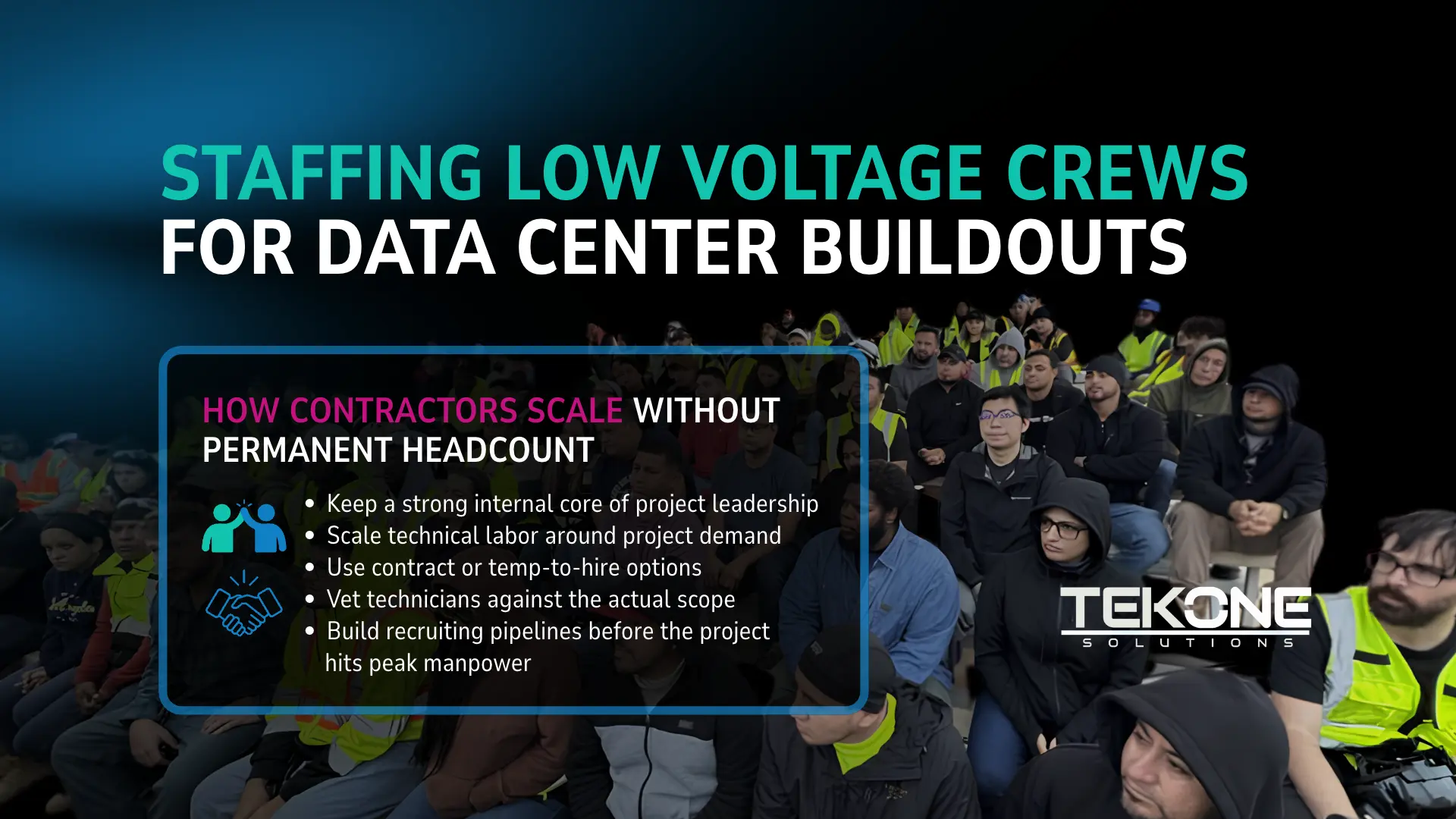
Data center buildouts rarely need the same low voltage headcount from start to finish.
A project may need a large crew during rough-in, cabling and fiber installation, then a much smaller team once it moves into testing, QA/QC and closeout.
That creates a real challenge for contractors. Hiring permanent employees for the absolute peak of one project can leave you carrying too much overhead when manpower drops back down.
A better approach is usually a mix of strong internal leadership and a staffing partner that can help scale around the project.
Why Peak Labor Is Hard to Staff Internally
Most contractors already have a core group of foremen, leads and experienced technicians they trust.
The issue comes when a hyperscale or mission-critical project suddenly needs 20, 50 or 100 additional people.
At that point, internal recruiting teams may not have the bandwidth, reach or technical recruiting experience to build the crew fast enough without lowering the bar.
That is where specialized low voltage staffing can help.
Technical Vetting Has to Go Beyond a Resume
Low voltage experience can mean a lot of different things.
Someone may have years in the industry but very little experience with data centers, high-count fiber, testing, QA/QC or large-scale structured cabling work.
Tek One uses video interviews and role-specific technical screening to get past the resume and understand what a technician has actually done.
For structured cabling and fiber roles, that may include questions around:
- Cable types and pathways
- Copper termination
- Fusion and ribbon splicing
- Fiber counts
- OTDR and OLTS testing
- Labeling and documentation
- Mission-critical project experience
For lead and QA/QC roles, the conversation goes further into troubleshooting, quality standards, documentation, crew leadership and how they handle issues in the field. Background checks and onboarding matter, but those are only part of the process. The bigger question is whether the technician fits the actual scope of work.
Scale the Crew as the Project Changes
- Data center schedules move fast, and manpower needs can change just as quickly.
- A project might ramp heavily for installation, hold steady for several weeks, then drop into a smaller testing and closeout phase.
- Using contract or temp-to-hire labor gives contractors more flexibility without building permanent headcount around a temporary peak.
- It also allows the internal team to stay focused on project execution instead of constantly recruiting around changing labor needs.
Nationwide Coverage Matters
Data center construction is no longer limited to the same major markets. More projects are being built in secondary cities and rural areas where the local labor pool can be limited.
Tek One supports data center and low voltage projects across the United States with W2 technicians working in structured cabling, fiber, security, telecommunications, AV, DAS/wireless and related infrastructure scopes.
For contractors working across multiple markets, that means they do not have to start over with a different labor source every time a new project opens.
A Practical Low Voltage Staffing Model for Data Center Contractors
For a lot of contractors, the model is pretty simple:
- Keep a strong internal core of project leadership
- Scale technical labor around project demand
- Use contract or temp-to-hire options where they make sense
- Vet technicians against the actual scope, not just the job title
- Build recruiting pipelines before the project hits peak manpower
The best staffing relationships get better over time.
Once a workforce partner understands your standards, your supervisors, the type of projects you run and what you expect from technicians, the process becomes more consistent from one project to the next.
Tek One works with contractors and integrators across structured cabling, fiber, security and data center infrastructure to help build that kind of workforce strategy.
The goal is not just to fill the next open seat. It is to help clients build a more flexible, reliable labor model that can support the next project too.
Planning manpower for an upcoming data center buildout?
Contact Tek One Solutions to discuss your project schedule, technical requirements and staffing strategy.

⟡

HEADQUARTERS
6421 Congress Ave, STE 102,
Boca Raton, FL 33487
Social Links
Tek One Solutions
We will only accept our clients
— 100% Absolute Satisfaction!